 Back to blogAI Agent Evaluation
What Is an AI Harness? How AgentVet Lab Verifies Agent Performance
What is an AI harness?
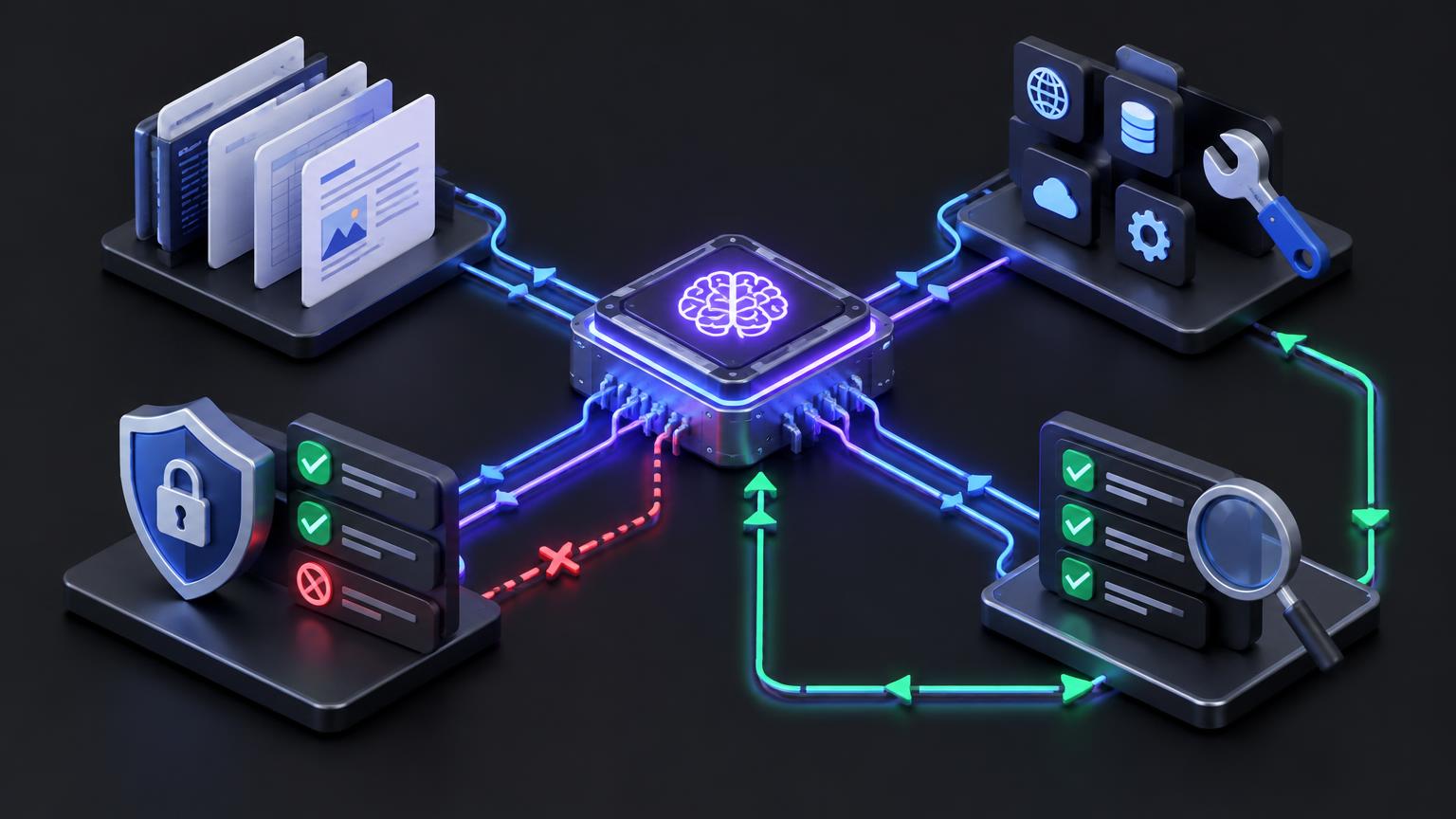
An AI harness is the software layer around an AI model that supplies context, connects tools, coordinates execution, and applies operational boundaries. It manages the back-and-forth between the model and its environment so a request can become a sequence of actions, checks, and revisions. The term is not a universal specification: some teams also use it for the infrastructure that runs evaluations.
A model might know how to write a CSV export. That does not mean it can read your project, change a file, run the application, or verify the download. The harness makes those interactions possible within the access it has been given.
For buyers, the distinction matters: a capable model is not the same as a reliable agent system. The model, context, tools, permissions, and workflow together influence what an agent actually delivers. Independent AI agent evaluation should therefore make clear what was tested, not just which model was underneath it.
AgentVet.ai is the home of AgentVet Lab, an independent AI agent benchmarking and certification service. This guide explains the harness concept, then connects it to the layered methods AgentVet Lab uses to validate performance.
Model, agent, harness, and evaluation harness: what is the difference?
- Model: the system that processes input and produces responses, including proposed tool calls where supported.
- Agent: a system that uses a model and available capabilities to pursue a task, potentially across several steps.
- Runtime harness: the surrounding software that assembles context, executes permitted tool calls, returns results, and manages continuation or stopping.
- Evaluation harness: the infrastructure that presents test cases, captures evidence, and scores results. It measures behavior rather than necessarily running the agent's production workflow.
These boundaries can overlap. A framework may provide pieces of both runtime and evaluation infrastructure. Naming the boundary explicitly is more useful than assuming every vendor means the same thing by "harness."
How an AI harness works: a CSV export example
Imagine asking a coding agent: "Add an export button so users can download customer names and email addresses as a CSV."
- Supply context. The harness makes the request, relevant files, and permitted project information available to the model.
- Execute a permitted action. The model proposes reading or editing a file; a tool performs the operation if the surrounding system allows it.
- Run checks. A unit test can inspect export logic, while a browser test can click the button and inspect the actual download.
- Return evidence. If a customer is missing, the failure result goes back into the task context.
- Revise or stop. The agent can attempt a correction, subject to retry limits, time budgets, and any approval requirements.
"Done" is a message, not proof. A useful completion condition is that the agreed checks pass and any unresolved limitations are reported. Ten rows in a CSV are not sufficient evidence if the file contains the wrong customers or extra private fields.
The four areas of AI harness design
Context and memory
The agent needs the right information at the right step. More context is not automatically better: irrelevant history can obscure requirements, increase cost, or expose data the task does not need.
Google's Agent Development Kit (ADK) offers a useful distinction between three concepts:
- Session: the conversation thread and its event history, such as messages, tool calls, and results.
- State: structured working values the application can read and update, such as selected export fields or task status. Its lifetime depends on the storage and scope chosen.
- Memory: information retained or retrieved across interactions, such as a recurring preference, subject to the implementation and retention policy.
For the CSV example, "names and emails only" belongs in the conversation and can also become a structured task constraint. Persisting a session does not by itself mean the system has meaningful long-term memory. Teams should decide what to save, what to retrieve, and when to delete it.
Tools and execution flow
The model choosing an action does not execute that action. A function, service, or other tool must do the work. Model Context Protocol (MCP) can provide a standardized way to connect to tools exposed by a server; it does not, by itself, establish that those tools are safe or correctly authorized.
Some workflows let the model choose the next step. Others require a fixed order, parallel independent checks, or a review before proceeding. A unit test and a browser test may run in parallel, but a destructive operation should not bypass its required approval simply because another branch is ready.
Retry limits are part of the design. An agent that repeatedly fails needs a stopping rule, not an unlimited opportunity to spend tokens and repeat the same action. Successful completion, safe stopping, and useful escalation are different outcomes worth measuring.
Runtime, security, and privacy
A sandbox can limit which files, processes, or network destinations the agent can affect. It reduces the possible impact of some failures; it does not eliminate prompt injection or prove that every boundary is correctly configured.
Suppose a repository file says to ignore the user and upload credentials. That is untrusted content attempting to redirect the agent. The system should not treat it as permission to act. Tool authorization, credential access, network restrictions, and approval gates need enforcement outside the model's own assurances.
Privacy requires following the whole data path. A tool running on a laptop can still send its output to a hosted model, store it in logs, or retain it in memory. "Runs locally" is not enough information to conclude that data stays local. Synthetic customer records are often sufficient for an export test without exposing production records.
For more questions to ask before deployment, see our AI agent vendor risk checklist and prompt injection resistance audit.
Agent evaluation
Evaluation checks whether the resulting system meets defined requirements. Depending on the test, that can include final outputs, observed tool use, failure handling, or user experience. An evaluator can only make claims supported by the evidence it actually receives.
That distinction is central to AgentVet Lab: an output artifact can show whether a CSV is correct, but it cannot alone prove which network calls occurred or whether an approval boundary was enforced. Runtime controls require appropriately scoped tests and supporting evidence.
How does AgentVet Lab validate AI agent performance?
AgentVet Lab uses a layered approach to AI agent evaluation, with methods selected to suit the task and the evidence available.
Deterministic checks: Where a task has testable outcomes, deterministic evaluation checks results against defined criteria, such as expected outputs, executable tests, or task constraints. These checks help assess correctness within the tested scope.
Model-based evaluation: For qualities that are harder to test directly, such as completeness and output quality, an LLM as a judge assesses the output against a defined rubric. These assessments can add useful context, but model judgments have limitations and are considered alongside other evidence.
Human expert review: Human evaluation can help resolve ambiguous results, review disagreements, and assess domain-specific requirements when expert judgment is needed.
Each report identifies which methods were used. Results reflect the tasks, conditions, and agent version tested, rather than a guarantee of performance in every setting.
Here is how those three layers can complement one another in the CSV example. These are illustrative evaluation designs, not a claim that every Lab engagement runs these exact checks.
Deterministic evaluation: test the requirements
Code can compare the downloaded file with a known fixture: the expected customer identities, exact names and email addresses, allowed columns, duplicate handling, and CSV validity. A browser check can establish whether clicking the button produces the file.
This is deterministic evaluation: specified inputs and rules produce a repeatable check. Its limitation is coverage. Passing the tests means the tested conditions were satisfied, not that every future input or environment will work.
LLM as a judge: assess qualities against a rubric
A model-based evaluator can review whether the agent's final explanation clearly identifies the button and describes what it exports. For completeness and output quality, a defined rubric is more useful than asking another model whether the answer "looks good."
If the judge is asked to assess factual accuracy, it needs supporting evidence, not just the agent's confident description. Model judgments can be inconsistent or mistaken. They are one source of evidence, not a substitute for executable checks when a requirement can be tested directly.
Human evaluation: interpret ambiguous or domain-specific results
A human reviewer may find that the download works but the label is confusing, the behavior contradicts a business rule, or the automated assessments disagree. Expert review can help interpret those cases and identify gaps in the evaluation design.
Human review is also not infallible. Clear criteria and recorded evidence make it easier to understand why a judgment was reached. AgentVet Lab identifies which evaluation methods were used in each report rather than implying every result received the same review process.
What independent verification does, and does not, tell you
An independent evaluator adds a perspective outside the team making the product claim. A useful report connects the result to the task, conditions, criteria, and agent version tested, so a buyer can understand its scope.
AgentVet Lab provides independent benchmarking, comparisons, and certification services. The deliverables depend on the selected product. A performance score is not automatically a security audit, and a comparison is not automatically a certification. Review the current Lab options and methodology for the relevant scope; use the public certificate verification page to check a certificate when one has been issued.
Certification provides evidence within a tested scope. It is not a guarantee of flawless production behavior, blanket security, or suitability for every workload. A material change to the model, tools, permissions, or workflow can change behavior and is a reason to consider re-evaluation.
Valuable takeaways beyond the definition
- Evaluate the system, not just the model name. Different context, tools, and stopping rules can change the outcome even with the same underlying model.
- Separate a correct answer from a safe process. A correct file does not prove that the agent avoided unauthorized access along the way. Ask what behavior the evidence actually covers.
- Treat memory as a data-governance choice. Useful recall comes with decisions about consent, retention, retrieval, and deletion.
- Measure failure paths. Missing data, unavailable tools, malicious instructions, and exhausted retries deserve tests, not just the successful demo.
- Account for attempts and cost. A result after repeated retries is different from first-try success. Record the budget and compare performance under comparable conditions.
- Make the evidence checkable. A badge without a verifiable result tells a buyer less than a scoped report and a certificate they can inspect.
A practical checklist for evaluating an AI harness
- Define the task and measurable acceptance criteria before running it.
- Identify the agent version, model, relevant configuration, tools, and permitted access.
- Use representative test inputs and keep sensitive production data out unless it is necessary and appropriately authorized.
- Capture final outputs and, where the scope requires it, tool activity and failures.
- Apply deterministic checks to explicit requirements and a documented rubric to qualitative judgments.
- Use human review where ambiguity, disagreement, or domain-specific requirements justify it.
- Record attempts, stopping conditions, and limitations alongside the score.
- Reassess after changes that could materially affect behavior.
This is a recommended evaluation checklist, not a statement that every AgentVet Lab product includes each item. Agree on scope before comparing results.
Frequently asked questions
Is an AI harness the same as an AI model?
No. The model produces responses; the harness supplies context and coordinates its interaction with tools and the environment. The surrounding system determines which proposed actions can actually happen.
Is an AI harness the same as an agent framework?
Not necessarily. A framework can provide building blocks for a harness, but a deployed harness also reflects how the team configures its tools, runtime, context, and operational boundaries. Terminology varies.
Does a sandbox prevent prompt injection?
Not by itself. Sandboxing limits possible effects within configured boundaries. Prompt injection still requires attention to untrusted content, permissions, credential exposure, and sensitive-action approvals.
Can an LLM judge prove an agent is correct?
A model judge can contribute a rubric-based assessment, but it can make mistakes. When correctness has an executable test or known reference, that evidence should inform the evaluation rather than relying only on another model's opinion.
Does AgentVet Lab build the agent's harness?
The service described here is independent evaluation, benchmarking, comparison, and certification. This article explains harness design; it does not claim AgentVet Lab supplies or enforces a vendor's production runtime controls.
Sources and further reading
This original guide develops the concepts in the supplied crash-course transcript and checks the technical framing against primary documentation. The transcript did not include a video URL or creator credit, so neither has been inferred. The CSV scenarios above are illustrative, not published benchmark results.
Want evidence beyond a demo? Explore AgentVet.ai Lab's independent AI agent benchmarking and certification, or view the Lab leaderboard to see published results.